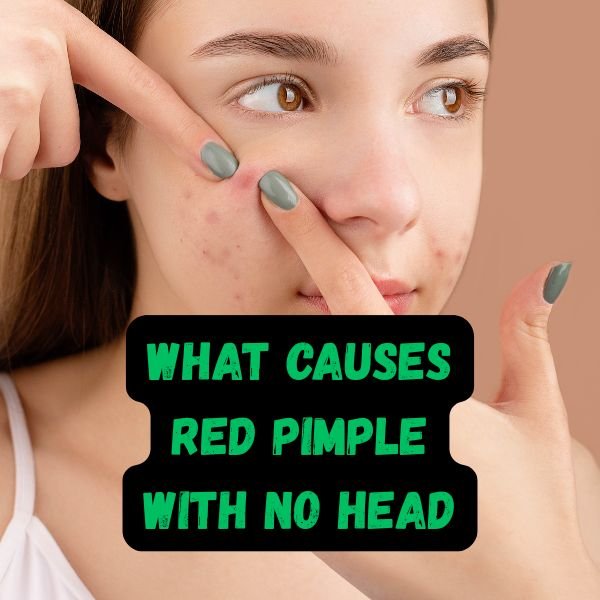
Have you ever noticed a red pimple with no head and wondered why it hurts when you touch it, yet there is no white spot to pop? These bumps can be annoying because they look like a typical pimple, but they don’t seem to have anything sitting on the surface. Sometimes they are small and tender, while other times they can feel like a hard lump underneath the skin.
The good news is that a pimple does not need a visible whitehead to be acne. When inflammation goes deeper into the skin, it can also form a nodule or cyst, which may feel more painful and harder to the touch.
So, why is your pimple red but has no head? Usually, it comes down to what is happening inside the pore rather than what you can see on the surface.
What Is a Red Pimple With No Head?
A red pimple with no head is usually an inflamed bump that does not have visible pus at the surface. In everyday language, we tend to think of a pimple as something with a white or yellow center. But acne can look quite different depending on how deep the inflammation is.
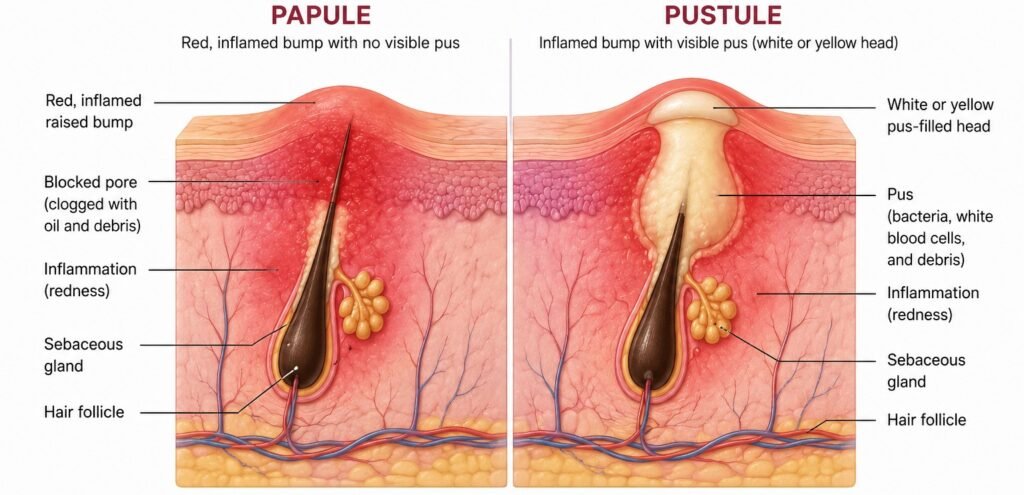
One common type is a papule. A papule is a small, raised, red or pink bump that forms when a blocked pore becomes inflamed. Unlike a pustule, it does not contain visible pus. That means there may be nothing white or yellow for you to see, even though the area is clearly irritated.
This is also why trying to squeeze a headless pimple often doesn’t work. There may simply be no “head” to remove. Instead, squeezing can irritate the surrounding skin and make the inflammation worse.
Why Does It Feel Painful?
Pain or tenderness can be a clue that the inflammation is happening deeper in the skin. When a blocked pore becomes significantly inflamed below the surface, it can develop into a nodule or cyst. These types of acne can feel like firm or painful lumps beneath the skin rather than ordinary surface-level pimples.
A deeper pimple can also take longer to settle down. You may notice that it feels sore when you wash your face, touch it, or even make certain facial movements. That does not automatically mean something is seriously wrong, but it is one reason you should resist the temptation to dig at it or repeatedly squeeze it.
What Causes a Red Pimple With No Head?
To understand why these pimples appear, it helps to look at what happens inside a hair follicle. Your skin contains tiny follicles connected to sebaceous glands. These glands produce sebum, an oily substance that helps keep your skin from becoming too dry.
Problems can start when the follicle produces too much oil and that oil mixes with dead skin cells. The mixture can form a plug inside the follicle. This blockage can lead to different forms of acne, including papules, pustules, nodules, and cysts.
Inflammation is the part that makes the bump red and swollen. Bacteria that normally live on your skin can also become involved inside a blocked follicle, contributing to the inflammatory process. So, what you see as a simple red bump may actually be the result of several things happening beneath the skin.
Hormones can play a role, too. During puberty, for example, hormonal changes can increase oil production, which is one reason acne is so common among teenagers. Hormonal fluctuations can also contribute to acne at other stages of life. Family history may matter as well, meaning some people are simply more likely to develop acne than others.
Other factors may trigger or worsen breakouts for some people. These can include certain cosmetics or medications, and some evidence also links high-glycemic diets with acne. However, acne isn’t simply a sign that someone has “dirty” skin, and washing your face excessively won’t fix the underlying problem. In fact, over-washing can irritate the skin and make things worse.
Why Is My Pimple Red but Has No Head?
If you’re asking this question while staring at a stubborn bump in the mirror, the simple answer is: a pimple can be inflamed without containing visible pus.
A white or yellow center usually means pus has collected close enough to the skin’s surface to be visible. A papule, on the other hand, does not contain pus, so it appears as a red or pink raised bump without a head.
A deeper nodule can also look like a headless pimple. In this case, the inflammation is deeper beneath the skin, which is why you may feel a firm, painful lump without seeing a whitehead.
That distinction matters because it explains why some pimples seem impossible to pop. If there is no visible head, there may be nothing at the surface that needs to come out. The better approach is usually to leave the bump alone and focus on calming the inflammation rather than trying to force it to the surface.
What Else Can Look Like a Red Pimple With No Head?
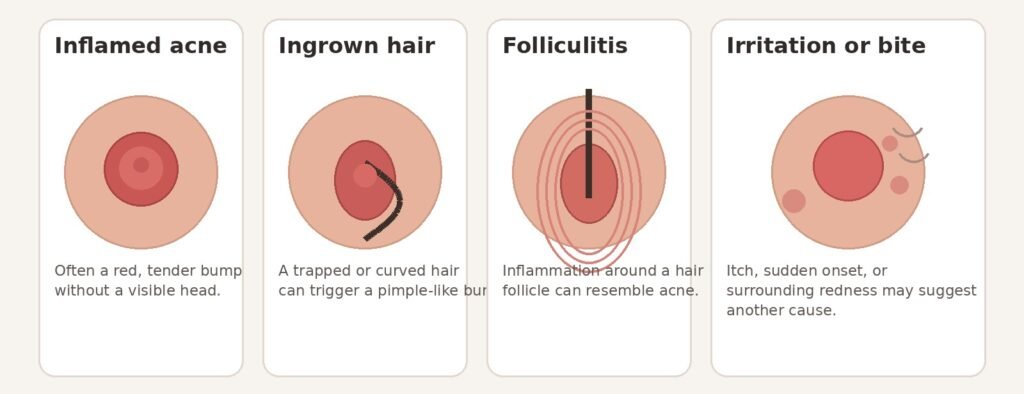
Not every red bump is necessarily acne. A bump caused by an ingrown hair, for example, can look surprisingly similar to a pimple, particularly if it appears after shaving or hair removal. Folliculitis, which involves inflammation around a hair follicle, can also produce red, tender bumps.
Skin irritation, an insect bite, or another inflammatory skin condition can sometimes resemble a pimple as well. This is especially worth keeping in mind if the bump is unusually itchy, appears suddenly, keeps returning in exactly the same place, or does not behave like your usual acne.
You don’t need to diagnose every bump yourself. If something looks unusual, becomes increasingly painful or swollen, spreads, or refuses to improve, getting it checked by a doctor or dermatologist is the safest option.
The important thing to remember is that a red pimple with no head is often simply an inflamed acne lesion. Understanding what is happening underneath the skin makes it easier to treat it appropriately-and, just as importantly, avoid making it worse by trying to pop it.
How to Treat a Red Pimple With No Head
Now that you know why a red pimple with no head can happen, the next question is probably the most important one: how do you get rid of it? The good news is that you usually don’t need to squeeze, poke, or pick at the bump. In fact, doing those things can make the problem worse. The goal is to reduce inflammation, keep the area clean, and give your skin time to heal.
How Do You Get Rid of a Pimple With No Head?
The first step is simple: leave it alone. It can be incredibly tempting to press on a painful bump to see if anything comes out, but a headless pimple may not have anything near the surface to remove. Squeezing can damage the surrounding skin and increase the chance of irritation, dark marks, and scarring.
For a deep, painful pimple, a warm compress can be a useful option. Place a clean washcloth soaked in warm—not hot—water against the area for around 10 to 15 minutes. This can help soothe the skin and may make the pimple more comfortable while it heals.
You can also consider an over-the-counter acne treatment. Ingredients such as benzoyl peroxide and salicylic acid are commonly used to manage acne. Benzoyl peroxide can help reduce acne-causing bacteria and inflammation, while salicylic acid helps remove dead skin cells and unclog pores.
Another option is adapalene, a topical retinoid that helps prevent clogged pores and can be useful for ongoing acne. Azelaic acid may also help with acne and the dark marks that can remain after a pimple heals. You don’t necessarily need to use all of these ingredients at once. Starting with one appropriate treatment and using it consistently is usually a better approach than covering your face with multiple strong products.
Should I Pop a Pimple That Has No Whitehead?
No, you should not pop it.
A pimple without a whitehead is especially difficult to pop because there may be no pus close to the skin’s surface. Trying to force one out can cause unnecessary damage.
Think of it this way: squeezing a deep pimple is a little like pressing on a bruise. You’re applying pressure to already irritated tissue, but you’re not necessarily removing the thing causing the inflammation.
Picking and squeezing can also increase the risk of acne scars and post-inflammatory hyperpigmentation, which are the dark or discolored marks that can remain after a breakout. The more aggressively you handle the pimple, the greater the chance that you’ll turn a temporary problem into a mark that lasts much longer.
If you accidentally squeeze it, don’t panic. Gently clean the area, avoid touching it again, and let the skin recover.
How Long Does a Red Pimple With No Head Last?
There isn’t one exact answer because it depends on the type and depth of the pimple.
A small papule may settle within several days, while a deeper inflammatory lesion can stick around for much longer. A nodule or cyst may take weeks to completely flatten.
It’s also possible for the redness or a dark mark to remain after the actual acne has gone away. This doesn’t necessarily mean the pimple is still active.
If a bump continues to grow, becomes increasingly painful, repeatedly appears in the same spot, or doesn’t improve over time, it’s worth talking with a healthcare professional rather than continuing to treat it yourself.
Can a Pimple With No Head Be Cystic Acne?
It can be, but not every headless pimple is cystic acne.
A small red bump without a head is often a papule. A deeper, harder, painful lump may be a nodule. Cystic acne is another form of deep inflammatory acne and can appear as a painful lump beneath the skin.
The tricky part is that these lesions can look similar, especially when you’re trying to identify them yourself. That’s why you shouldn’t automatically assume that every painful, headless bump is a cyst.
One useful clue is depth. If the bump feels like a hard lump underneath the skin and is particularly painful, it may be a deeper form of acne. Deep lesions are more likely to leave scars, so they are also a good reason to consider seeing a dermatologist if they happen regularly.
When Is a Red Bump Not Actually a Pimple?
Sometimes, what looks like a red pimple with no head isn’t acne at all.
For example, an ingrown hair can create a red, tender bump around a hair follicle. This is particularly common after shaving, waxing, or other forms of hair removal. Folliculitis can also cause clusters of red or irritated bumps around hair follicles.
An insect bite may be red and swollen but often feels more itchy than a typical acne lesion. Skin irritation or an allergic reaction can produce similar-looking bumps as well.
Pay attention to how the bump behaves. If it is extremely itchy, spreads quickly, appears in an unusual pattern, or doesn’t resemble your normal breakouts, don’t assume it’s acne. A doctor or dermatologist can help determine what’s actually causing it.
When Should You See a Dermatologist?
Most occasional pimples don’t require a doctor’s appointment. However, persistent, painful, or recurring acne deserves more attention.
Consider seeing a dermatologist if you regularly develop deep nodules or cysts, your acne is leaving scars, or over-the-counter treatments aren’t helping. You should also get a bump evaluated if it becomes very swollen or painful, continues getting worse, or doesn’t seem to be healing normally.
Professional treatment can be especially helpful for deep acne because these lesions can cause permanent scarring. A dermatologist can determine what type of acne you’re dealing with and recommend treatments based on its severity.
It’s also worth seeking medical advice if you’re suddenly developing significant acne as an adult, particularly if you have other symptoms that could suggest an underlying hormonal issue.
How Can You Prevent Red Pimples Without a Head?
You can’t prevent every pimple, but a consistent skincare routine can reduce breakouts.
Start with a gentle cleanser rather than aggressively scrubbing your face. Washing too often or using harsh products can irritate your skin without actually preventing acne.
Choose non-comedogenic skincare and makeup products when possible. These are designed to be less likely to clog pores. If you sweat heavily, gently cleansing afterward can also help remove sweat, oil, and buildup.
Most importantly, resist picking at existing pimples. Touching your face throughout the day can irritate an already inflamed spot, while squeezing can increase the risk of scarring.
If you frequently get acne, prevention usually works better when you treat the problem consistently rather than waiting for individual pimples to appear. An appropriate acne ingredient, such as salicylic acid, benzoyl peroxide, or adapalene, may help depending on your skin and the type of acne you experience.
Frequently Asked Questions
Why is my pimple red but has no head?
A red pimple with no head is often an inflamed papule. It may also be a deeper acne lesion, such as a nodule, where the inflammation is below the skin’s surface. Because there is no pus sitting near the surface, you may not see a whitehead.
How do I get rid of a pimple with no head?
Don’t squeeze or puncture it. A warm compress can help soothe a painful bump, while appropriate acne ingredients such as benzoyl peroxide or salicylic acid may help manage acne. Give the skin time to heal.
Should I pop a pimple that has no whitehead?
No. If there is no visible head, there may be nothing to remove. Squeezing can increase inflammation and raise the risk of scarring and dark marks.
How long does a headless pimple take to go away?
It depends on the type of lesion. A small papule may improve within several days, while deeper acne can last considerably longer. Persistent or recurring bumps should be evaluated by a healthcare professional.
Can a pimple with no head be cystic acne?
Yes, a deep acne lesion can lack a visible head. However, a headless pimple isn’t automatically cystic acne. It could simply be an inflamed papule or another type of skin bump.
When is a red bump not actually a pimple?
Ingrown hairs, folliculitis, insect bites, and skin irritation can all resemble acne. If a bump is unusually itchy, painful, persistent, spreading, or different from your normal breakouts, consider getting it checked.