You notice a small crust on your skin after scratching an insect bite or accidentally cutting yourself. A few days later, it starts itching. You may be tempted to peel it off, but another scab forms underneath. Even more frustrating is finding scabs on your scalp, face or other parts of your body without remembering an injury.
So, why does this happen?
Scabs are a normal part of the skin’s healing process. They form when blood and wound fluid dry over damaged skin, creating a temporary protective covering. However, repeatedly developing scabs can sometimes point to an underlying skin condition, infection or habit of scratching.
What Are Scabs and Why Do They Form?
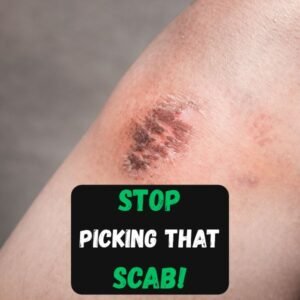
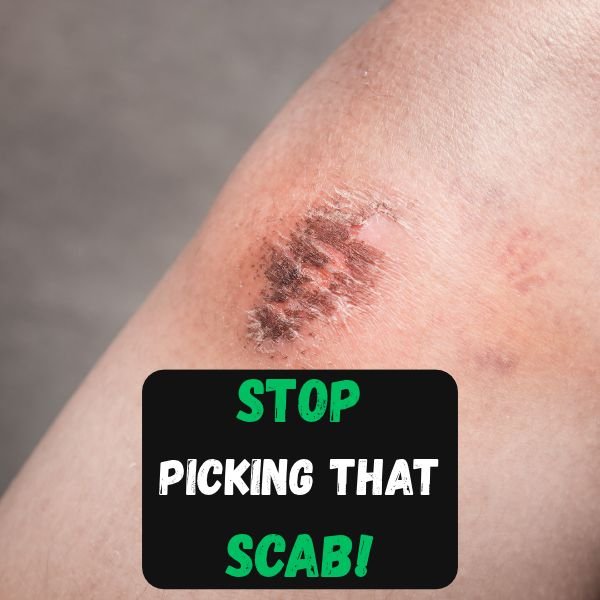
A scab is a dry, crust-like covering that develops over damaged skin. It forms when blood, platelets and other substances involved in clotting combine to seal a wound.
When you cut, scratch or otherwise injure your skin, tiny blood vessels break and release blood. Platelets gather at the damaged area and help form a clot. A protein called fibrin strengthens this clot, helping stop the bleeding.
As the wound begins to heal, blood and wound fluid dry on the surface, forming the familiar crust we call a scab.
Think of a scab as your body’s temporary protective cover. It helps shield the injured area from dirt, friction and further damage while new skin develops underneath.
The healing process involves several overlapping stages:
- Clotting: Platelets and fibrin help stop bleeding and seal the wound.
- Inflammation: Immune cells move into the area to remove bacteria, damaged cells and debris.
- Tissue repair: New skin cells gradually grow across the wound, while the body produces collagen to support tissue repair.
- Remodelling: The repaired tissue gradually strengthens and becomes more stable.
Once the skin underneath has healed sufficiently, the scab usually loosens and falls off naturally.
However, not every crust on the skin is a normal healing scab. Some skin conditions and infections can also produce crusting that looks similar. This distinction becomes particularly important when scabs keep returning.
Why Do You Keep Getting Scabs on Your Skin?
If you frequently notice scabs on different parts of your body, the first thing to consider is what might be repeatedly irritating or damaging your skin.
Sometimes, the explanation is straightforward. You may be scratching dry skin, picking at small bumps or unknowingly irritating an existing skin condition. In other cases, an infection or inflammatory disorder may be responsible.
Here are some common possibilities.
1. Repeated scratching
Scratching is one of the most common reasons for recurring scabs. When your skin becomes itchy, scratching can break its surface and cause minor bleeding. As the wound dries, a scab develops.
This can become a frustrating cycle: itching leads to scratching, scratching damages the skin, and the resulting inflammation causes even more itching.
2. Eczema and dermatitis
Conditions such as atopic dermatitis and contact dermatitis cause skin inflammation, dryness and itching. Persistent scratching can create small wounds that ooze fluid and eventually develop crusts.
With eczema, you may notice dry, rough patches alongside scabs. Contact dermatitis may develop after exposure to irritating substances, fragrances, soaps or certain skincare products.
3. Insect bites
Mosquitoes, fleas and other insects can leave itchy bumps that are easy to scratch, particularly during sleep. Repeated scratching can break the skin and create small scabs.
4. Skin infections
Bacterial infections, including folliculitis and impetigo, can cause bumps, pustules and crusted lesions. Depending on the infection, you may also notice redness, tenderness, swelling or discharge.
5. Skin picking
Some people repeatedly pick at small bumps, acne spots or rough patches without fully realising how often they do it. This behaviour can prevent wounds from healing and cause new scabs to form in the same areas.
If scabs keep appearing despite reasonable skin care, it is worth investigating the underlying cause rather than repeatedly treating the crust itself.
Why Do Scabs Itch While Healing?
If you’ve ever had a scab that seemed perfectly fine until it suddenly started itching, you’ve experienced a normal part of the wound-healing process. In most cases, mild itching is a sign that your skin is repairing itself.
As your body heals an injury, it releases chemical messengers that coordinate inflammation and tissue repair. Some of these substances, including histamine, can stimulate itch-sensitive nerve endings in the surrounding skin. This is why a healing wound may feel itchy even when there is no infection.1
Dryness can make the sensation worse. As wound fluid dries and the scab forms, the surrounding skin may become tight, flaky or irritated. Meanwhile, new skin cells are gradually growing underneath to cover the damaged area. This developing tissue can also feel sensitive as healing progresses.
Although mild itching is common, don’t assume that every itchy scab is healing normally. If the itching becomes increasingly intense or occurs alongside spreading redness, swelling, warmth, pain or unusual discharge, an infection or ongoing skin inflammation may be responsible.
As tempting as it may be, try not to scratch. It might relieve the itching temporarily, but breaking the scab can reopen the wound and delay healing.
How to Treat Scabs, Speed Up Healing and Know When to Worry
How Do You Get Rid of Scabs Fast?
When you have a visible scab, especially on your face or another exposed area, it is natural to want it gone as quickly as possible. However, removing a scab prematurely can do more harm than good.
The best way to help a scab heal faster is to support the skin’s natural repair process rather than trying to remove the crust.
Here is what you can do:
1. Clean the affected area gently
Wash the area with clean, lukewarm water and a mild cleanser. Avoid scrubbing, rubbing or using harsh products that can irritate the healing skin.
If the wound is fresh, gentle cleaning helps remove dirt and reduces the risk of infection.
2. Keep the scab lightly moisturized
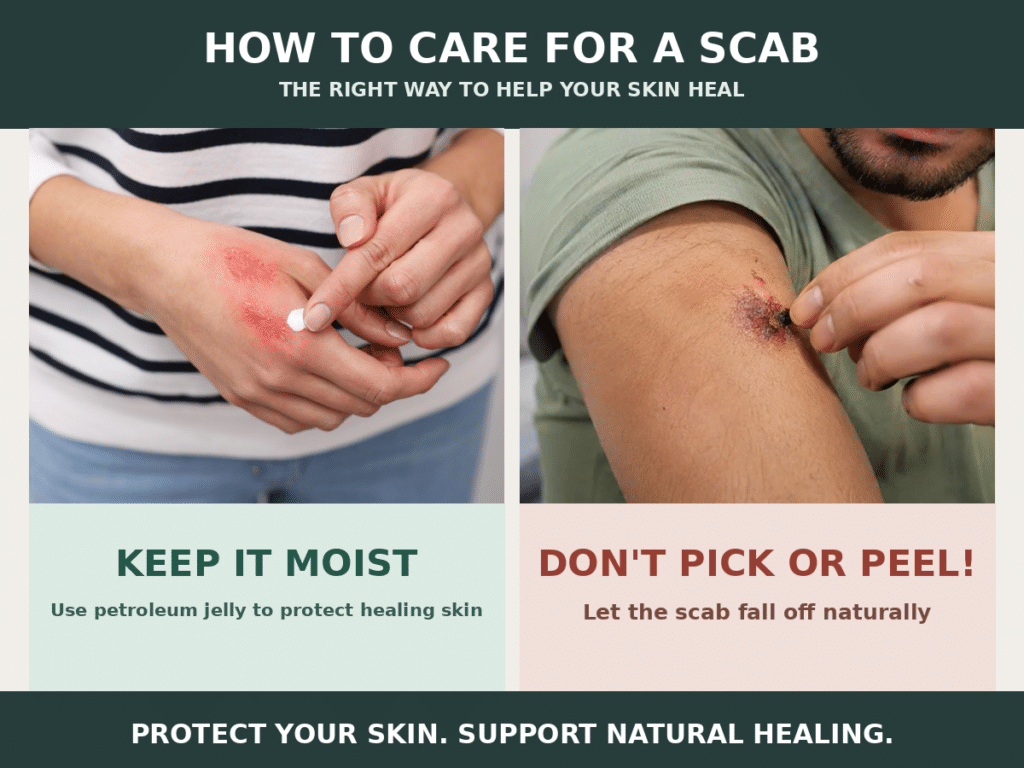
Applying a thin layer of petroleum jelly can prevent the wound from drying out excessively. It helps maintain a suitable environment for new skin cells to grow across the damaged area.
Contrary to popular belief, allowing a wound to become extremely dry and cracked does not necessarily make it heal faster.
3. Protect the area with a bandage
For wounds that may rub against clothing or get exposed to dirt, a clean, non-stick dressing can help protect the healing skin.
Change the dressing regularly and whenever it becomes wet or dirty.
4. Avoid picking or scratching
Picking at a scab can reopen the wound, cause bleeding and increase the risk of infection. It can also prolong healing and make scarring more likely.
5. Address the underlying cause
If scabs develop because of eczema, folliculitis or another skin condition, treating the underlying problem is just as important as caring for the wound.
For example, repeatedly applying moisturizer to scabs caused by an untreated bacterial infection will not resolve the infection.
One important thing to remember: there is no safe overnight method to remove a scab. Your goal should be to help the skin heal properly, not simply make the crust disappear.
Should You Keep a Scab Dry or Moisturised?
You may have grown up hearing that wounds should be left open to the air so they can dry out. However, dermatologists often recommend a different approach for minor cuts, scratches and superficial wounds: moist wound healing.
Keeping a wound lightly moisturized helps new skin cells move across the damaged surface more easily. It also prevents the surrounding skin from becoming excessively dry and cracked, which can interfere with healing.2
Petroleum jelly is a simple and inexpensive option. Applying a thin layer after gently cleaning the wound can help maintain moisture and protect the developing skin.
However, moist does not mean soaking wet. Excessive moisture can soften the surrounding skin, making it look whitish, wrinkled or soggy. This is known as maceration. When it occurs, the skin barrier becomes weaker and more vulnerable to further damage.
The goal is to maintain a balanced environment. Clean the wound gently, apply a small amount of petroleum jelly and use a suitable dressing if the area needs protection. Change the dressing regularly and avoid prolonged soaking.
If a wound is unusually deep, appears infected or produces significant discharge, routine home care may not be enough. It should be assessed by a healthcare professional.
Is It Bad to Pick or Peel Off Scabs?
Yes. Picking or peeling a scab before it falls off naturally can interfere with the healing process. Even when the edges start lifting and the surface looks dry, the skin underneath may not be fully repaired.3
A scab acts as a temporary protective covering over developing tissue. Removing it too early can expose the delicate skin underneath, causing bleeding and reopening the wound. Your body then has to repair the damaged area again, which can prolong healing.
Picking also increases the risk of infection because it can introduce bacteria into the exposed tissue. Repeated trauma may contribute to scarring, while the inflammation caused by scratching and picking can leave dark marks known as post-inflammatory hyperpigmentation.
This is particularly frustrating when scabs appear on the face, where even a small wound can leave a noticeable mark after healing.
If you find yourself picking scabs frequently, try covering the affected area with a suitable dressing. Keeping your nails short can also reduce accidental damage. It may help to notice when you tend to pick, such as when you’re stressed, bored or experiencing persistent itching.
For some people, skin picking becomes difficult to control, even when they know it is damaging their skin. This behaviour can sometimes be associated with excoriation disorder, a condition involving repeated picking that causes skin lesions. If picking is causing ongoing wounds or distress, a healthcare professional can help.
How Long Does It Take for a Scab to Heal?
Most minor scabs heal within approximately 1-2 weeks, although the actual time depends on the size, depth and location of the injury.
A small scratch may heal within a few days, while a deeper wound can take several weeks or longer. Scabs on areas that experience frequent movement or friction may also take longer to settle.
Healing is not always straightforward. An infected wound may remain inflamed for longer, while repeatedly scratching or picking at a scab can reopen it and delay recovery. Certain health conditions, including diabetes and poor circulation, can also interfere with the body’s ability to repair damaged tissue.
Age, nutritional status and immune function play a role too. For example, inadequate protein intake or certain nutritional deficiencies can affect tissue repair.
As healing progresses, you should generally notice that the surrounding redness and tenderness decrease, the wound becomes smaller and the scab gradually loosens. It should eventually fall away on its own, revealing the new skin underneath.
If a wound remains open, repeatedly bleeds, becomes larger or shows no signs of improvement, don’t simply wait for the scab to disappear. A dermatologist should examine it, particularly if it has persisted for several weeks without an obvious explanation.
Are Scabs a Sign of Infection?
Not necessarily. A scab is a normal part of wound healing, and its presence alone does not mean that an infection has developed.
However, certain changes around a scab can suggest that bacteria have entered the wound.
Watch for the following signs:
- Increasing redness: Some redness is normal immediately after an injury. However, redness that spreads or becomes progressively worse may indicate infection.
- Swelling and warmth: The surrounding skin may become increasingly swollen, tender or warm to the touch.
- Pus or unusual discharge: Thick yellow, greenish or cloudy discharge may indicate infection, although dried wound fluid can also appear yellowish.
- Increasing pain: A healing wound should generally become less uncomfortable over time. Pain that worsens rather than improves deserves attention.
- Spreading crusted sores: Some bacterial infections, particularly impetigo, can cause multiple superficial sores with characteristic honey-colored crusts.
- Fever: Fever, chills or feeling generally unwell alongside an infected-looking wound can indicate a more significant infection.
If you notice spreading redness, worsening pain, pus or fever, seek medical advice promptly. Rapidly spreading redness, severe pain or feeling very unwell warrants urgent assessment.
A dermatologist can examine the affected area and determine whether you need antibiotics, a wound culture or another form of treatment.
When Should You Worry About a Scab That Won’t Heal?
Most minor wounds heal without complications. However, a scab that repeatedly returns or refuses to heal should not be ignored.
Sometimes the reason is an ongoing skin condition, repeated scratching or an infection that has not been treated properly.
In other cases, a persistent crusted area may represent a skin lesion that needs further investigation.
Pay particular attention if a scab:
- Continues bleeding without an obvious reason.
- Repeatedly forms in exactly the same place.
- Becomes larger instead of gradually healing.
- Develops increasing redness, pain or discharge.
- Does not heal despite appropriate wound care.
- Develops alongside a persistent ulcer, lump or unusual skin growth.
Certain skin cancers, including basal cell carcinoma and squamous cell carcinoma, can sometimes resemble a sore or scab that repeatedly heals and reappears.
This does not mean every persistent scab is cancer. However, a lesion that does not heal, repeatedly bleeds or changes in appearance should be examined by a dermatologist. A biopsy may be recommended if the appearance raises concern.
People with diabetes, poor circulation or weakened immune systems should also seek medical advice earlier when wounds are not healing as expected.
Frequently Asked Questions
Q. Why Are My Scabs Yellow or Honey-Colored?
A. Yellowish scabs can develop when wound fluid, known as serum, dries on the skin. This can occur during normal healing and does not automatically mean you have an infection.
However, thick, golden or honey-colored crusts are a characteristic feature of impetigo, a contagious bacterial skin infection.
Impetigo often begins as small red sores or blisters that rupture and develop yellowish crusts. It commonly affects the face, particularly around the nose and mouth, although it can appear elsewhere.
If you notice spreading sores, increasing redness, tenderness or discharge, consult a healthcare professional. Impetigo often requires antibiotic treatment.
Q. Why Do Scabs Leave Dark Marks After Healing?
A. Have you noticed that a small pimple or scratch disappears, but a brown or dark mark remains in its place?
This is often due to post-inflammatory hyperpigmentation (PIH).
When skin becomes inflamed or injured, pigment-producing cells called melanocytes may increase melanin production. This extra pigment can remain in the affected area even after the wound has healed.
Dark marks are particularly common in people with darker skin tones.
Picking, scratching and repeated irritation can increase inflammation and make pigmentation more noticeable.
Q. Why Do Scabs Keep Coming Back in the Same Place?
A. Scabs that repeatedly appear in the same location may indicate that something is continuously damaging or irritating that area.
Common explanations include:
- Repeated scratching or picking.
- Persistent eczema or dermatitis.
- Recurrent folliculitis.
- A skin infection that has not fully resolved.
- Repeated friction or minor trauma.
However, a sore or crusted lesion that repeatedly heals and reappears in exactly the same location deserves closer attention.
Occasionally, persistent skin lesions can be associated with precancerous changes or skin cancer.
If the same area repeatedly develops a scab without a clear explanation, arrange a dermatological examination rather than repeatedly removing the crust.
Q. Why Do I Keep Getting Scabs on My Face?
A. Recurring facial scabs are commonly associated with acne, eczema, impetigo, contact dermatitis and repeated skin picking.
For example, squeezing pimples can break the skin and cause crusting. Similarly, irritation from skincare products may lead to inflammation, scratching and small wounds.
If the scabs are concentrated around your nose and mouth and develop yellowish crusts, impetigo is another possibility.
Avoid picking at the affected areas and discontinue products that appear to irritate your skin. Persistent, painful or spreading facial sores should be assessed by a dermatologist.
Q. Should You Keep a Scab Dry or Moisturized?
A. For most minor wounds, lightly moisturizing the area with petroleum jelly is preferable to allowing it to become excessively dry and cracked.
Moist wound healing supports the movement of new skin cells across the damaged area and helps prevent the wound from drying out.
However, avoid excessive moisture, which can soften and damage the surrounding skin.
Q. When Should You Worry About a Scab That Won’t Heal?
A. A scab that does not improve, repeatedly bleeds or keeps returning in the same place should be examined.
You should also seek medical advice if you notice spreading redness, pus, increasing pain, swelling or fever.
Persistent sores sometimes require further investigation to rule out chronic infections, inflammatory skin conditions and, less commonly, skin cancer.