
Have you noticed that your knuckles are becoming darker than the rest of your hands? Perhaps the skin around your finger joints looks brown, black, or unusually thick, even though the surrounding skin appears normal.
You’re not alone. Dark knuckles, sometimes called black knuckles, are a common concern. In some people, the change is simply due to repeated friction and thickening of the skin. But in others, it can be associated with vitamin deficiencies, insulin resistance, hormonal disorders, or certain medications.
The important thing is that dark knuckles are not always just a cosmetic problem.
For example, vitamin B12 deficiency can cause pigmentation over the knuckles, while insulin resistance may produce dark, thickened skin known as acanthosis nigricans. A similar appearance can also occur in Addison’s disease, a condition affecting the adrenal glands.
So, what exactly causes dark knuckles? Can a vitamin deficiency be responsible? And more importantly, how can you get rid of black knuckles?
Let’s understand the six important causes and how to identify them.
Why Are Your Knuckles Darker Than the Rest of the Hands?
Before discussing individual causes, it’s important to understand why the skin becomes darker in the first place.
Your skin contains a pigment called melanin, which gives it its natural colour. When melanin production increases or pigment accumulates in certain areas, the skin can become darker. This is called hyperpigmentation.
However, not every case of dark knuckles is caused by excess melanin alone.
Sometimes, repeated friction causes the skin to become thicker. In other situations, hormonal or metabolic changes affect the skin’s appearance.
This is why two people with apparently similar black knuckles may actually have completely different underlying problems.
Let’s look at the six important possibilities.
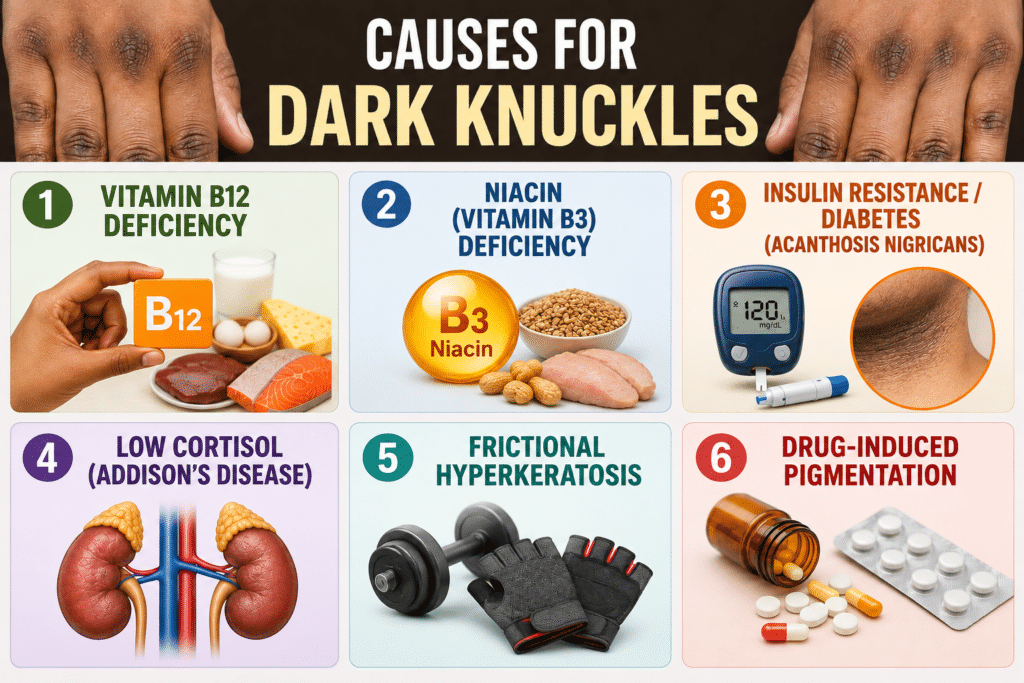
6 Causes of Dark Knuckles You Should Know About
1. Vitamin B12 Deficiency
Did you know that a vitamin deficiency can sometimes make your knuckles darker?
Vitamin B12 is essential for healthy nerve function, red blood cell production, and DNA synthesis. When your body doesn’t get enough of it, several changes can occur, including increased pigmentation of the skin.
Interestingly, the pigmentation may be particularly noticeable over the knuckles, hands, feet, and sometimes the oral mucosa.
You may also experience:
- Unusual tiredness or weakness
- Tingling or numbness in the hands and feet
- Difficulty concentrating
- Soreness of the tongue
- Pale skin due to associated anaemia
One important clue is that pigmentation associated with vitamin B12 deficiency may involve the palms, soles, and oral mucosa rather than being restricted to the knuckles.
If vitamin B12 deficiency is suspected, a blood test can help confirm the diagnosis.
Can dark knuckles caused by vitamin B12 deficiency be reversed?
In many cases, pigmentation improves after correcting the deficiency. However, recovery takes time, and the extent of improvement varies from person to person.
Simply applying a skin-lightening cream will not correct an underlying vitamin deficiency.
2. Niacin (Vitamin B3) Deficiency
Another nutritional deficiency that can affect skin pigmentation is niacin deficiency, also known as pellagra.
Niacin is important for energy production and the normal functioning of skin cells.
When your body doesn’t receive enough niacin, it can develop a characteristic skin condition called pellagra.1
One of its important features is a dark, rough, inflamed rash over areas exposed to sunlight.
You may notice:
- Dark, thickened skin over the hands
- Rough or scaly patches
- Redness and inflammation followed by pigmentation
- Similar changes over the neck, face, and other sun-exposed areas
A classic feature of pellagra is pigmentation over the backs of the hands, sometimes with a sharp demarcation at the wrist.
Unlike isolated frictional dark knuckles, niacin deficiency usually produces a more widespread pattern of skin changes.
It can also cause diarrhoea and neurological or cognitive symptoms. The classic combination is sometimes described as the three Ds: dermatitis, diarrhoea, and dementia.
Can niacin deficiency cause black knuckles?
Yes, it can contribute to dark pigmentation over the hands, although isolated dark knuckles are not a typical presentation. The associated rash and other symptoms help distinguish it from other causes.
Treatment involves correcting the nutritional deficiency and addressing its underlying cause.
3. Insulin Resistance and Diabetes (Acanthosis Nigricans)
If your knuckles have become darker and the skin also feels unusually thick or velvety, consider a condition called acanthosis nigricans.
This is one of the important skin changes associated with insulin resistance.2
Insulin is a hormone that helps glucose enter your cells. In insulin resistance, the body’s cells respond less effectively to insulin, so the body may produce more of it.
Higher insulin levels can stimulate changes in skin growth, leading to thickened, darker patches.
Acanthosis nigricans commonly affects:
- Back of the neck
- Underarms
- Groin
- Knuckles and finger joints
- Other skin folds
The affected skin often looks darker, feels thicker, and has a velvety texture.
Are dark knuckles a sign of diabetes?
Not necessarily. Dark knuckles alone do not mean you have diabetes.
However, when the pigmentation has the characteristic appearance of acanthosis nigricans, it may indicate underlying insulin resistance and an increased risk of type 2 diabetes.
A doctor may recommend tests such as fasting blood glucose and HbA1c, depending on your clinical findings and risk factors.
The important point is to address the underlying metabolic problem rather than relying only on skin-lightening products.
4. Low Cortisol (Addison’s Disease)
This is one of the less commonly recognised causes of dark knuckles.
Addison’s disease, also called primary adrenal insufficiency, occurs when the adrenal glands fail to produce sufficient cortisol.
Cortisol is an important hormone involved in regulating blood pressure, metabolism, and the body’s response to stress.
But how does low cortisol cause dark skin?
When cortisol production falls, the body increases the production of ACTH (adrenocorticotropic hormone) to stimulate the adrenal glands.
ACTH is derived from a larger molecule that also gives rise to melanocyte-stimulating peptides. These can stimulate melanin production, resulting in increased skin pigmentation.
You may notice darkening around:
- Knuckles and finger joints
- Palmar creases
- Elbows and knees
- Gums and oral mucosa
- Areas exposed to friction
Other symptoms may include:
- Persistent fatigue and weakness
- Unexplained weight loss
- Dizziness or low blood pressure
- Nausea and abdominal discomfort
- Salt craving
Can Addison’s disease cause sudden dark knuckles?
The pigmentation usually develops gradually, although people may notice it suddenly. It can sometimes be one of the visible clues to an underlying adrenal disorder.
If you have unexplained pigmentation along with weight loss, dizziness, or persistent weakness, medical evaluation is important.
5. Frictional Hyperkeratosis
Sometimes, the explanation for dark knuckles is much simpler: repeated friction.
Your hands are constantly exposed to pressure and rubbing. Activities such as weightlifting, manual labour, frequent scrubbing, and handling tools can repeatedly irritate the skin over the finger joints.
In response, the skin may become thicker as a protective mechanism. This thickening is known as hyperkeratosis.
Over time, the affected areas can appear darker, rougher, and more prominent than the surrounding skin.
You may notice:
- Thickened skin over the knuckles
- Rough or dry patches
- Darkening concentrated over pressure points
- A history of repetitive rubbing or manual work
Unlike acanthosis nigricans, frictional hyperkeratosis is usually more localised to areas exposed to repeated pressure.
How do you get rid of dark knuckles caused by friction?
The first step is to reduce repeated rubbing and pressure.
You can also consider moisturisers containing urea or lactic acid to soften thickened skin. Avoid aggressive scrubbing, as irritation can make pigmentation worse.
If the skin continues to thicken or darken despite reducing friction, a dermatologist can help determine whether another condition is responsible.
6. Drug-Induced Pigmentation
Have your knuckles become darker after starting a new medication?
Certain medicines can cause changes in skin pigmentation. This is known as drug-induced pigmentation.
The pigmentation may develop gradually over weeks or months, depending on the medication and individual response.
Some medications associated with pigmentation changes include:
- Minocycline
- Antimalarial medications such as hydroxychloroquine
- Certain chemotherapy drugs
- Amiodarone
- Some other medications that affect skin pigmentation
The appearance can vary. Some drugs cause diffuse pigmentation, while others may produce more localised or patterned changes.
How can you identify drug-induced dark knuckles?
One important clue is the timing.
If you notice new pigmentation after starting a medication, your doctor may consider whether the medicine is responsible.
However, don’t stop a prescribed medicine on your own. Discuss the pigmentation with your treating doctor, who can assess whether a medication change is appropriate.
How Can You Tell What Is Causing Your Dark Knuckles?
This is where the clinical appearance and associated symptoms become important.
Although different conditions can produce similar-looking pigmentation, certain clues may help identify the underlying cause.
| Appearance or associated finding | Possible cause |
|---|---|
| Dark knuckles with fatigue and tingling | Vitamin B12 deficiency |
| Dark, rough skin with photosensitive rash | Niacin deficiency |
| Dark, thick, velvety skin on the neck and underarms | Acanthosis nigricans |
| Dark knuckles with weight loss, dizziness and low blood pressure | Addison’s disease |
| Thickened skin at repetitive pressure points | Frictional hyperkeratosis |
| Pigmentation appearing after a new medication | Drug-induced pigmentation |
Remember, these are clues rather than diagnostic rules. A proper examination is sometimes necessary to distinguish between them.
How to Get Rid of Dark Knuckles: What Actually Helps?
The treatment of dark knuckles depends on what is causing the pigmentation.
There is no single cream that works for everyone because the underlying mechanisms can be very different.
For example, using a pigmentation cream may help certain types of superficial hyperpigmentation, but it will not correct vitamin B12 deficiency or insulin resistance.
Here are some approaches that may help depending on the cause.
1. Moisturisers Containing Urea or Lactic Acid
If your knuckles are thick, rough, and dry, moisturisers containing urea or lactic acid may help.
Urea softens thickened skin while improving hydration. Lactic acid provides gentle exfoliation and also helps attract moisture.
These ingredients are particularly useful when frictional hyperkeratosis contributes to the dark appearance.
2. Niacinamide
Niacinamide is a form of vitamin B3 commonly used in skincare products.
It can help improve uneven skin tone by reducing the transfer of melanin to surrounding skin cells. It also supports the skin barrier and may help reduce irritation.
It can be considered for certain types of superficial hyperpigmentation.
However, topical niacinamide is not a substitute for treating dietary niacin deficiency.
3. Azelaic Acid
Azelaic acid is another ingredient used to manage hyperpigmentation.
It helps regulate pigment production and can be useful in certain pigmentation disorders.
Its suitability depends on the underlying diagnosis and the sensitivity of your skin.
4. Retinoids
Topical retinoids can help improve certain forms of hyperpigmentation by influencing skin cell turnover.
However, they can also cause irritation, dryness, and peeling, particularly when introduced too aggressively.
Since irritation itself can worsen pigmentation, retinoids should be used carefully and ideally under dermatological guidance.
5. Treat the Underlying Medical Condition
This is probably the most important part of managing dark knuckles.
If pigmentation is caused by vitamin B12 deficiency, correcting the deficiency is essential.
If acanthosis nigricans is associated with insulin resistance, managing the underlying metabolic problem is more important than simply applying skin-lightening creams.
Similarly, Addison’s disease requires appropriate medical treatment, while drug-induced pigmentation requires a review of the suspected medication.
The best dark knuckles treatment is the one that addresses the actual cause.
What Should You Avoid If You Have Dark Knuckles?
One common mistake is trying to remove pigmentation by scrubbing the skin aggressively.
This can cause irritation and inflammation, potentially making the pigmentation worse.
Avoid:
- Harsh physical scrubs and abrasive brushes
- Frequent use of strong exfoliating acids without guidance
- Unregulated skin-lightening creams
- Applying multiple active ingredients simultaneously
- Using steroid-containing combination creams without medical advice
- Taking vitamin supplements without establishing whether a deficiency exists
If your knuckles have become darker recently, identifying the cause should come before experimenting with different products.
When Should You See a Dermatologist for Dark Knuckles?
Not every case of dark knuckles indicates a medical problem. However, certain changes deserve attention.
Consider seeing a dermatologist if:
- Your knuckles have become darker suddenly or progressively.
- The pigmentation is spreading to your palms, elbows, knees, or other areas.
- Your skin has become unusually thick or velvety.
- You also experience fatigue, weakness, tingling, or unexplained weight loss.
- You notice dizziness, low blood pressure, or other unusual symptoms.
- The pigmentation started after beginning a new medication.
- Skincare products and moisturisers have not helped.
Depending on your examination, your dermatologist may recommend investigations such as vitamin B12 levels, blood glucose, HbA1c, thyroid-related tests, or adrenal function tests.
Not everyone needs all these investigations. The choice depends on the clinical findings and associated symptoms.
The good news is that many causes of dark knuckles can be managed once identified. The important thing is not to assume that every case requires a skin-lightening cream.
Frequently Asked Questions
Q. Why are my knuckles darker than the rest of my hands?
A. Dark knuckles can develop due to several reasons, including frictional hyperkeratosis, insulin resistance, vitamin deficiencies, Addison’s disease, and certain medications.
The appearance and associated symptoms help determine the likely cause. Dark knuckles are often harmless, but new or progressive pigmentation deserves attention.
Q. Which vitamin deficiency causes dark knuckles?
A. Vitamin B12 deficiency is a recognised cause of skin hyperpigmentation, particularly over the knuckles, hands, and feet.
Niacin (vitamin B3) deficiency can also cause dark, rough pigmentation over sun-exposed areas, including the backs of the hands, as part of a condition called pellagra.
Q. Are dark knuckles a sign of diabetes?
A. They can sometimes be associated with diabetes or insulin resistance.
A condition called acanthosis nigricans produces dark, thickened, velvety skin, commonly affecting the neck, underarms, groin, and sometimes knuckles.
However, dark knuckles alone do not confirm diabetes. Blood tests such as fasting glucose and HbA1c may be recommended when clinically appropriate.
Q. Can dark knuckles be reversed?
A. In many cases, yes. Improvement depends on the underlying cause and how long the pigmentation has been present.
Correcting nutritional deficiencies, managing insulin resistance, reducing friction, and treating other underlying conditions can help improve pigmentation.
However, some pigmentation may take several months to fade, and complete reversal is not always possible.
Q. How to get rid of dark knuckles naturally?
A. Start by identifying the cause. Reduce repeated friction, use a suitable moisturiser, and protect your hands from excessive sun exposure.
Avoid harsh scrubbing, lemon juice, and unregulated bleaching remedies, as these can irritate the skin and worsen pigmentation.
If the pigmentation is related to a medical condition, home remedies alone will not correct it.
Q. Which cream is best for dark knuckles?
A. There is no universally best cream for dark knuckles.
Depending on the cause, products containing urea, lactic acid, niacinamide, or azelaic acid may help improve certain forms of pigmentation and thickened skin.
However, if the pigmentation is caused by a vitamin deficiency, insulin resistance, or Addison’s disease, the underlying condition needs appropriate treatment.
Q. Can friction cause black knuckles?
A. Yes. Repeated pressure and rubbing can cause the skin over the knuckles to become thickened and rough. This is called frictional hyperkeratosis.
Reducing friction and using suitable moisturisers may gradually improve the appearance.
8. Can Addison’s disease cause dark knuckles?
Yes. Addison’s disease can cause increased pigmentation due to increased ACTH production when cortisol levels are low.
The pigmentation may be particularly noticeable over the knuckles, palmar creases, elbows, knees, and oral mucosa.
It may occur alongside fatigue, weight loss, dizziness, and low blood pressure.
Q. How long does it take to lighten dark knuckles?
A. There is no fixed timeline.
Mild pigmentation related to friction may improve over several weeks to months after reducing repeated irritation. Pigmentation caused by nutritional or hormonal disorders may take longer to improve, even after appropriate treatment.
The underlying cause, duration of pigmentation, and individual skin response all influence recovery.
Q. When should I worry about dark knuckles?
A.You should seek medical evaluation if dark knuckles appear suddenly, spread progressively, become thick and velvety, or occur alongside symptoms such as unexplained weight loss, fatigue, tingling, dizziness, or increased thirst.
A dermatologist can examine the pigmentation and determine whether further investigations are necessary.