Have you ever looked closely in the mirror after a summer vacation and suddenly noticed tiny brown dots scattered across your cheeks or nose? For some people, freckles feel charming and unique. For others, they become a source of worry. I often meet patients who ask questions like: Why am I suddenly getting freckles on face? Are freckles genetic and do they need to be treated or will they fade on their own?
The confusion is understandable because not every brown spot on the face is actually a freckle. Some are harmless sun spots, while a few may need medical attention.
What Are Freckles?
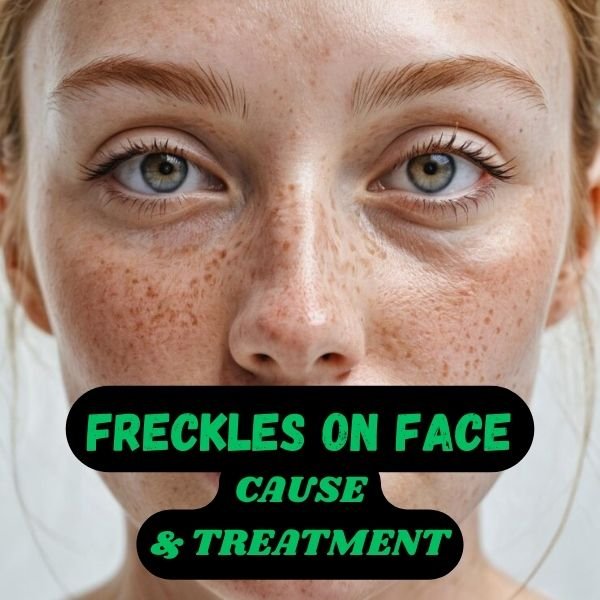
Freckles are small flat brown spots that develop because of increased pigment production in the skin. They usually appear on areas exposed to sunlight, especially the:
- Nose
- Cheeks
- Forehead
- Shoulders
- Upper arms
Unlike raised moles, freckles are usually completely flat and painless.
The medical term for common freckles is ephelides. These are especially common in people with lighter skin tones, light-colored eyes, or a family history of freckles.
One interesting thing about freckles is that they are related to sun exposure. Many people notice they become darker during summer and lighter during winter. That happens because freckles are your skin’s response to ultraviolet (UV) light.
How Do Freckles Appear on Face?
This is probably the most common question people ask.
Freckles appear when your skin produces extra melanin after sun exposure. Melanin is the pigment that gives color to your skin, hair, and eyes.
When sunlight hits the skin, specialized cells called melanocytes start producing more pigment to protect deeper layers of the skin from UV damage. In some people, this pigment gets distributed unevenly in tiny concentrated spots, which become freckles.
Even a small amount of repeated sun exposure can trigger freckles in genetically prone individuals.
I often notice that patients who develop freckles usually have one or more of these:
- Fair or sensitive skin
- History of sunburns
- Family members with freckles
- Frequent outdoor activity
- Inconsistent sunscreen use
Interestingly, freckles often start appearing during childhood or teenage years and become more visible after outdoor exposure.
Are Freckles on Face Genetic?
Yes – genetics plays a very important role.
If your parents or grandparents had freckles, there is a higher chance you may develop them too.
Certain genes, especially the MC1R gene, influence how your skin responds to sunlight. People with these genetic traits tend to produce pigment differently when exposed to UV rays.1
This is why two people can spend the same amount of time in the sun, but only one develops freckles.
However, genetics alone is not enough. Sun exposure is usually the trigger that “activates” freckles.
That’s why some people notice their freckles becoming darker after vacations, outdoor sports, or long hours in sunlight.
Are Brown Spots on Face Cancer?
This is where many people become anxious.
The good news is that most freckles are harmless and non-cancerous.
However, not every brown spot is a freckle.
Some spots may actually be:
- Sun spots (solar lentigines)
- Moles
- Post-inflammatory pigmentation
- Seborrheic keratoses
- Rarely, early skin cancer
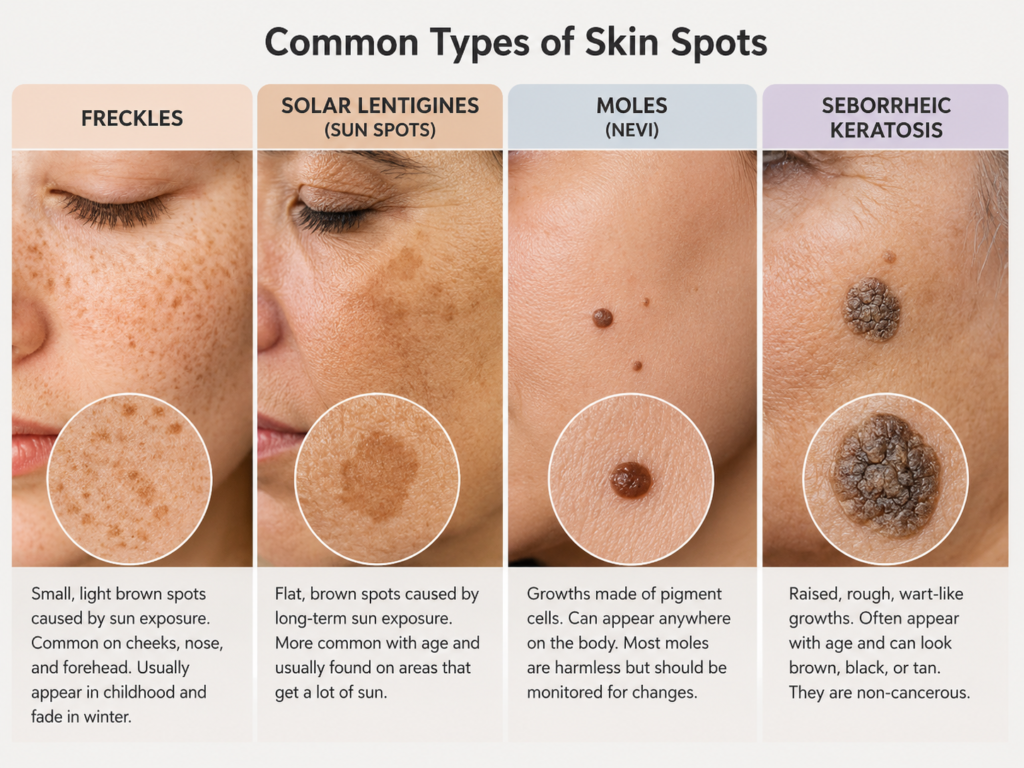
So how do you know when a spot needs attention?
As a dermatologist, I advise patients to watch for these warning signs:
Warning Signs to Never Ignore
- Rapid increase in size
- Irregular borders
- Multiple colors within one spot
- Bleeding or crusting
- Persistent itching
- Sudden appearance of a very dark lesion
A useful rule doctors use is the ABCDE rule:2
A – Asymmetry
B – Border irregularity
C – Color variation
D – Diameter enlargement
E – Evolution or change
If a brown spot changes noticeably over time, it deserves professional evaluation.
Most freckles stay stable for years. Changing lesions are the ones we worry about.
Do Freckles on Face Fade?
Yes, many freckles do fade naturally.
This especially happens when sun exposure decreases.
For example, some people notice:
- Freckles become darker during summer
- They lighten during winter
- Sunscreen helps prevent darkening
These are classic freckles.
However, there is another type of pigmentation called solar lentigines or “age spots.” These usually appear later in life and may not fade easily.
Freckles may also fade slowly with:
- Consistent sunscreen use
- Skin renewal
- Reduced tanning
- Pigment-control skincare
But if someone continues frequent sun exposure without protection, freckles usually return or become darker again.
Can Freckles on Face Be Removed?
Yes, freckles can often be reduced or removed.
But this depends on:
- Depth of pigmentation
- Skin type
- Sun exposure habits
- Type of freckles
Some patients only want mild fading, while others want near-complete removal.
Common Treatment Options
1. Sunscreen
This sounds simple, but it is honestly the most important step.
Without sun protection, freckles tend to return even after treatment.
A broad-spectrum sunscreen with SPF 30 or higher is essential.
2. Pigment-Lightening Creams
Dermatologists may prescribe creams containing:
- Retinoids
- Azelaic acid
- Vitamin C
- Hydroquinone (in selected cases)
These work gradually and usually require patience.
3. Chemical Peels
Chemical peels help remove superficial pigmented skin layers and may improve freckles over multiple sessions.
They also brighten overall skin tone.
4. LASER Treatment
Laser treatment is one of the most effective options for freckles.
Technologies like:
- Q-switched lasers
- Pico lasers
- IPL (Intense Pulsed Light)
can selectively target pigment with impressive results.
Many patients see noticeable improvement after a few sessions.
However, proper assessment is extremely important because treating the wrong lesion with lasers can sometimes be risky.
Can Freckles Be Removed Permanently?
This is where expectations need to be realistic.
Existing freckles can often be removed successfully. But if your skin is genetically prone to freckles and you continue getting sun exposure, new freckles may appear later.
That is why maintenance and sun protection matter just as much as treatment.
Final Thoughts
Freckles are usually harmless pigment spots caused by a combination of genetics and sunlight. For many people, they are simply a natural skin feature.
But not every brown spot should be ignored.
If you notice a spot changing in shape, color, size, or behavior, getting it examined early is always the safer choice.
And if freckles are affecting your confidence, modern dermatology offers several safe and effective treatment options.
The key is understanding what your skin is trying to tell you – instead of blindly treating every brown spot the same way.
References
- Bastiaens M, ter Huurne J, Gruis N, Bergman W, Westendorp R, Vermeer BJ, Bouwes Bavinck JN. The melanocortin-1-receptor gene is the major freckle gene. Hum Mol Genet. 2001 Aug 1;10(16):1701-8. doi: 10.1093/hmg/10.16.1701. PMID: 11487574.
- https://www.skinhealthinfo.org.uk/wp-content/uploads/2020/10/ABCDE-A4-border-2016.pdf