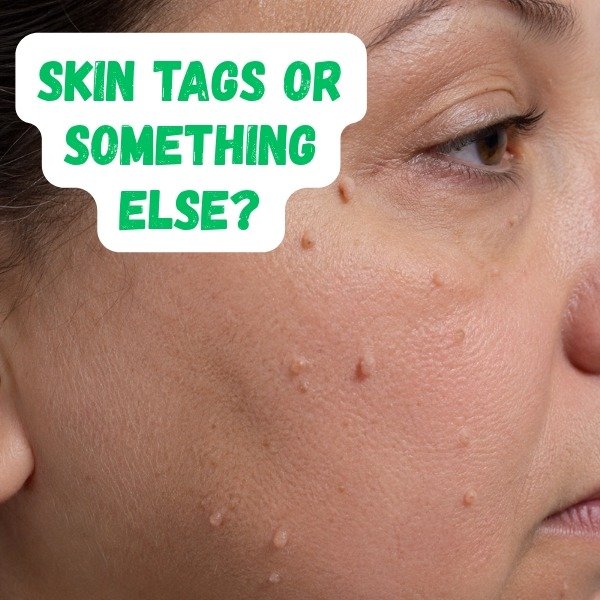
You notice a small bump on your face while looking in the mirror. A quick internet search tells you it’s probably a skin tag. As a dermatologist, I can tell you that many facial bumps people call “skin tags” are actually something else entirely. In fact, true skin tags on face are less common than many people think. Conditions such as dermatosis papulosa nigra (DPN), skin-colored moles, and other harmless growths are often mistaken for skin tags.
The good news is that most of these growths are benign. The challenge is figuring out exactly what they are before deciding whether they need treatment.
What Are Skin Tags?
Skin tags are small, soft growths that hang off the skin by a thin stalk. Their medical name is acrochordon.
They are usually flesh-colored or slightly darker than the surrounding skin. Most skin tags are painless and harmless, although they can become irritated if repeatedly rubbed.
Skin tags tend to appear in areas where skin rubs against skin, such as:
- The neck
- Armpits
- Groin
- Under the breasts
- Eyelids
While skin tags can occur on the face, they are not the most common cause of facial bumps.
Why Do Skin Tags Develop?
We do not know the exact reason, but several factors increase the likelihood of developing skin tags:
- Genetics
- Increasing age
- Obesity
- Insulin resistance and diabetes
- Friction between skin surfaces
If your parents seem to collect skin tags like souvenirs, there is a fair chance you may develop them too.
Are All Skin Tags on Face Actually Skin Tags?
Not necessarily.
This is where things become interesting.
When patients visit my clinic complaining of “skin tags on the face,” many turn out to have a completely different condition. To an untrained eye, several skin growths can look remarkably similar.
The appearance, color, texture, and attachment to the skin often provide clues, but sometimes a closer examination is needed.
Let’s look at the most common look-alikes.
Dermatosis Papulosa Nigra (DPN): The Most Common Imposter
If you have multiple small brown or black bumps on your cheeks, temples, or around your eyes, there is a good chance they are not skin tags at all.
They may be dermatosis papulosa nigra, commonly called DPN.
DPN is especially common in individuals with darker skin types and often runs in families.
What Does DPN Look Like?
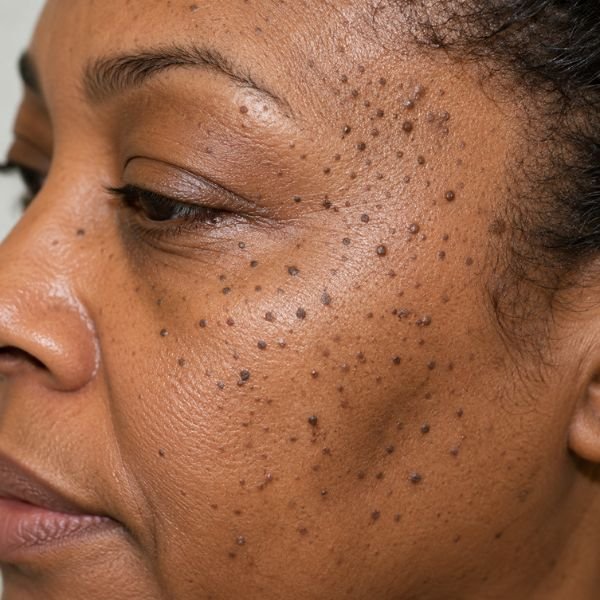
DPN appears as:
- Small brown or black bumps
- Multiple lesions rather than a single growth
- Smooth or slightly rough surface
- Gradual increase in number with age
Patients often tell me, “My mother had exactly the same spots.“
That family history is often a valuable clue.
Can DPN Be Removed?
Yes.
Common treatment options include:
- Radiofrequency removal
- Electrocautery
- LASER treatment
These procedures are usually quick and performed in the clinic.
Intradermal Nevus: A Skin-Colored Mole
Another common source of confusion is the intradermal nevus.
This is simply a mole that sits deeper within the skin. Unlike the dark moles many people imagine, intradermal nevi are often flesh-colored or pink.
As a result, they can easily be mistaken for skin tags.
How Does a Mole Differ from a Skin Tag?
A skin tag usually hangs from a narrow stalk.
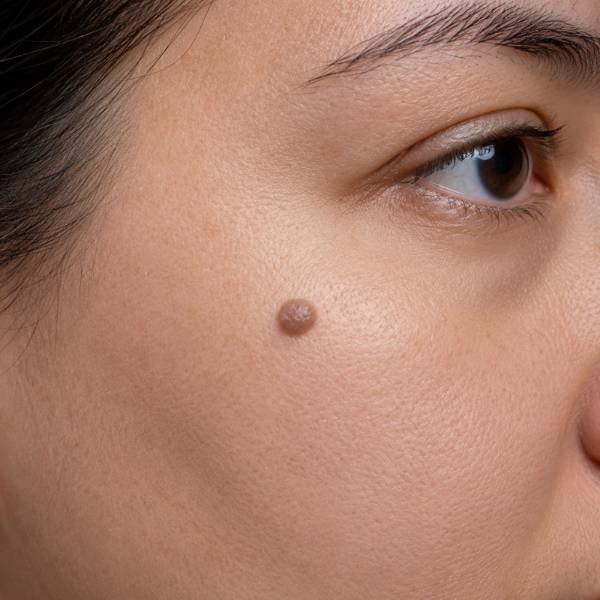
An intradermal nevus typically:
- Has a broader base
- Appears dome-shaped
- Feels slightly firmer
- May contain hairs
Finding a hair growing from the lesion is often a clue that you are looking at a mole rather than a skin tag.
Other Growths That May Look Like Skin Tags on Face
Several other harmless conditions can create small raised bumps on the face.
Seborrheic Keratosis
Seborrheic keratoses are very common as people age.
They often look:
- Waxy
- Slightly raised
- Brown, black, or tan
- As if they were “stuck onto” the skin
While some are flat, smaller lesions can occasionally resemble skin tags.
Fibrous Papule
A fibrous papule is a small, firm bump that often develops on the nose or central face.
It is benign and generally remains stable for years.
Neurofibroma
Neurofibromas are soft skin-colored growths that can occasionally resemble skin tags.
Although usually harmless, they should be evaluated by a dermatologist if newly appearing or increasing in number.
Can Skin Cancer Look Like a Skin Tag?
Occasionally, yes.
Most facial growths are benign, but some skin cancers can mimic harmless lesions during their early stages.
This is why self-diagnosis has limits.
You should seek medical evaluation if a growth:
- Enlarges rapidly
- Bleeds without injury
- Develops a persistent crust
- Changes color
- Becomes painful
- Forms an ulcer
Most of the time, the lesion will turn out to be harmless. However, identifying the rare exceptions early is important.
How Dermatologists Diagnose Facial Skin Growths
Many diagnoses can be made through a careful examination.
Dermatologists assess:
- Shape
- Color
- Surface texture
- Pattern of growth
- Location
A dermoscope, which provides magnified visualization of the skin, often helps distinguish between different lesions.
In uncertain cases, a small biopsy may be recommended. This involves removing part or all of the growth and examining it under a microscope.
Treatment Options for Skin Tags on Face
Treatment depends on the diagnosis.
What works well for a skin tag may not be the ideal approach for a mole or DPN.
Radiofrequency Removal
Radiofrequency surgery is one of the most precise methods for removing small facial growths.
Benefits include:
- Minimal bleeding
- Quick procedure
- Good cosmetic results
Electrocautery
Electrocautery uses controlled heat to remove lesions.
It is commonly used for:
- Skin tags
- DPN
- Small benign growths
Laser Removal
Lasers can be useful for selected lesions, particularly when cosmetic outcomes are a priority.
Surgical Excision
Some lesions, especially moles, are best removed surgically.
This allows complete removal and provides tissue for microscopic examination if necessary.
Is It Safe to Remove Facial Skin Tags at Home?
The internet is full of creative ideas.
Some involve tying string around a growth. Others involve over-the-counter freezing products. A few suggestions are best described as “please don’t.”
The problem is not just the risk of scarring or infection. The bigger issue is misdiagnosis.
If the bump is not actually a skin tag, home treatment may be ineffective, damaging, or delay proper diagnosis.
The face is not the place for unnecessary experiments.
When Should You See a Dermatologist?
Consider professional evaluation if:
- You are unsure what the growth is
- The lesion is changing
- It bleeds repeatedly
- It causes cosmetic concerns
- You want safe removal with minimal scarring
A correct diagnosis often takes only a few minutes and can save considerable worry.
Frequently Asked Questions
Q. Are skin tags on the face dangerous?
A. No. True skin tags are benign and do not become cancerous.
Q. Can DPN be permanently removed?
A. Individual lesions can usually be removed successfully, although new lesions may develop over time.
Q. How do I know whether a bump is a mole or a skin tag?
A. The distinction is not always obvious. Dermatological examination is often the most reliable way to tell.
Q. Do skin tags grow back after removal?
A. Removed skin tags generally do not return, but new skin tags may develop elsewhere.
Q. Can skin cancer look like a skin tag?
A. Occasionally, yes. Any changing or suspicious growth should be evaluated.